Amelie Lens b2b Sara Landry at Magazine Open-Air: The Night the Crowd Held the Room
CABBA LAGA reports from Broadwick's new riverside site: the PA failed mid-set, Sara Landry soundchecked with the crowd, and the night came back louder.
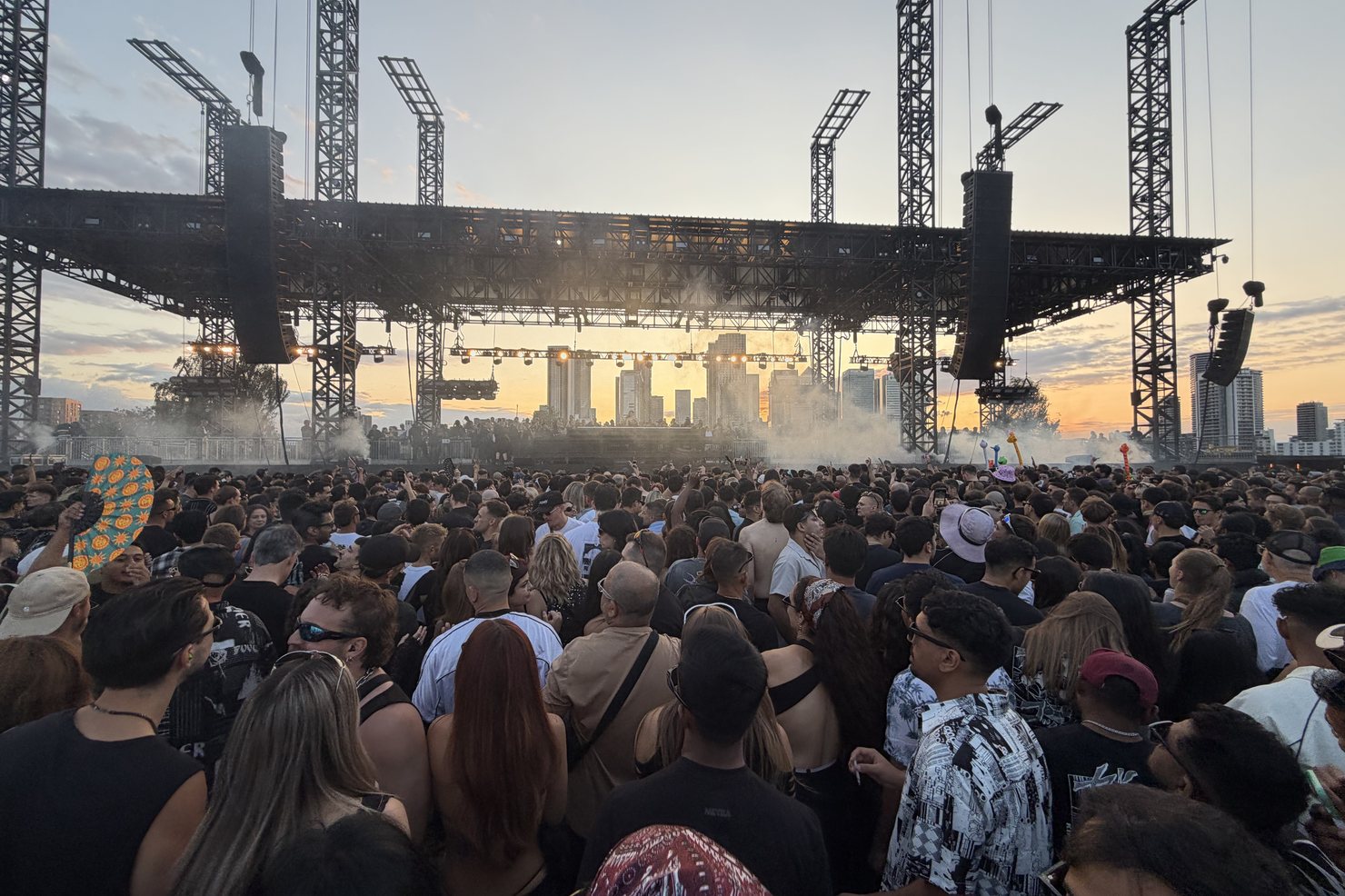
The bill promised the first Amelie Lens b2b Sara Landry in London, a UK exclusive on a riverside site Broadwick Live had never used before. What Friday 21 August will actually be remembered for is the quarter of an hour when the sound system gave out under the headline set, and what five thousand people did while they waited. CABBA LAGA reported from the floor for House of MNEEMO, with Ravi Sharma, founder of Neon Black, alongside him.
Magazine Open-Air is the newest project from the group behind Printworks and Drumsheds: six open-air dates across August on the Greenwich Peninsula, a roofless dancefloor squeezed between Magazine London's black monolith and the Thames, with Canary Wharf stacked up across the water. Friday was the hard techno night: Amelie Lens and Sara Landry sharing top billing, with SPFDJ, Dax J, Grace Dahl and DJ Hyperdrive underneath. On paper, the toughest card of the series. In practice, a night that tested something no line-up can: what a London crowd does when the music stops.
The night the PA blinked
It happened after Sara Landry came to the front. A crackle first: the kind of intermittent interference you get from a bad jack contact, multiplied through a festival rig. Then unmistakable distortion riding over the mix from one side of the system. The set was stopped. For roughly ten to fifteen minutes the biggest hard techno booking of London's summer stood on a silent stage while engineers worked behind her.
Nobody booed. That is the detail worth printing. The crowd read it instantly for what it was: a technical failure, the kind that happens in this industry every week, nothing the artist controls. So they decided to hold the room themselves. Phones came out, but not to film the malfunction: people started playing Sara Landry tracks off Spotify, pockets of the field vibing to her own catalogue on phone speakers while she waited to return to it properly.
Then the fix itself turned into a collaboration. Landry asked the field, directly, how it sounded, and the field answered. People pointed to where the balance was off; at one point half the crowd was gesturing at the right-hand stack, where the system sounded like it was running hot. A soundcheck conducted by five thousand assistants. When she finally dropped back in, with an enormous track and no easing into it, the place detonated. The cheer for her return was louder than anything the system had produced before it failed.
Here is the strange upside: the sound came back better. Before the failure the system had moments of being simply too loud, pressure on the ears at the front. After the repair it ran slightly quieter and noticeably cleaner: comfortable, for the rest of the night, without earplugs. Whatever the engineers changed under pressure, the second half of the set was the best the rig sounded all day.
The two names on the flyer
It is worth pausing on how heavy this billing actually was. Sara Landry (real name, no alias: the rare headline act performing under the name on her passport) has been named the world's No.1 Hard DJ in DJ Mag's poll and sits at No.62 in the 2025 DJ Mag Top 100, running her own label HEKATE since 2021 specifically so she owns her masters. Her breakout was itself a London-adjacent story: the 2023 Boiler Room x Teletech set that passed six million views, followed by an all-night-long Teletech date at E1 and another at Archives. Our own profile of her, written before this show, ended on the observation that a truly big London date was less a question of if than when. Friday was the when: open air, on a shared headline bill, at a scale her all-night club dates in this city never had.
Amelie Lens arrived carrying a different kind of momentum: her debut album AURA, 11 tracks, came out on 4 September via her own EXHALE Records, which means London caught her exactly two weeks before the most personal release of her career. The Belgian has history with Broadwick rooms (her EXHALE party took over Drumsheds in March 2024 with Dax J and SPFDJ on the bill, both of whom resurfaced on Friday's flyer) and history with this partnership too: her first-ever b2b with Landry closed the RESISTANCE stage at Ultra Miami in March 2026. Five months later, London got the first hometown-continent edition, billed by the venue as their first London b2b and a UK exclusive. Bookings like this are why the field filled in five minutes.
The undercard alone would headline most London club nights. SPFDJ, Swedish-born and Berlin-based, is a Herrensauna resident who runs the Intrepid Skin label; Dax J is a London-born, Berlin-based institution who has run Monnom Black since 2013; Amsterdam's Grace Dahl is a Vault Sessions resident with her own SDT Recordings imprint; and Berlin's DJ Hyperdrive, a resident of the city's Crude parties, folds trance and hardtrance into high-speed techno. Four accents of the same storm, carrying the field from the 16:00 gates to the headline slot.
A field built by the Drumsheds people
Standing in the middle of it, CABBA LAGA's instinct was that the whole thing felt like Drumsheds: the scale, the branding, the screens pushing upcoming shows. The instinct is exactly right, because it is the same operation: Broadwick Live runs both, and Magazine Open-Air is their bet that the formula works without a roof. The series pulls no punches on programming: Meduza with James Hype, Josh Baker b2b Max Dean, Soulection, Purple Disco Machine. Friday's hard techno card sat at the heaviest end of it.
The site has history buried under it. Magazine London takes its name from the government gunpowder magazine that stood on this peninsula from the 1690s: for decades the state's main store for freshly milled powder, until locals petitioned Parliament long enough that the whole dangerous operation was moved downriver to Purfleet in the 1760s. The street outside is still called Ordnance Crescent. The venue itself is young, a purpose-built black box from 2019 with a 3,000-capacity main room, but the open-air series happens beside it, on ground that had never been used for shows before this summer.
Hard techno's London summer
Zoom out and Friday reads as one chapter of a longer story: London is currently absorbing hard techno at a speed nobody predicted. In February, Teletech, the promoter whose Boiler Room broadcast launched Landry to six million views, joined forces with The Warehouse Project and Broadwick for Teletech XXL at Drumsheds, the largest UK Teletech event ever staged, in a room licensed for 14,999. The genre's London trajectory over two and a half years runs from an E1 all-nighter to a Tottenham mega-club to, now, a riverside field at golden hour. Putting the hardest card of the Open-Air series outdoors, in daylight, next to the tourists and the cable car, is the most confident statement yet that this sound has outgrown the basement, and the mixed-generation crowd that filled the field looked exactly like a genre mid-crossover.
The space, read honestly
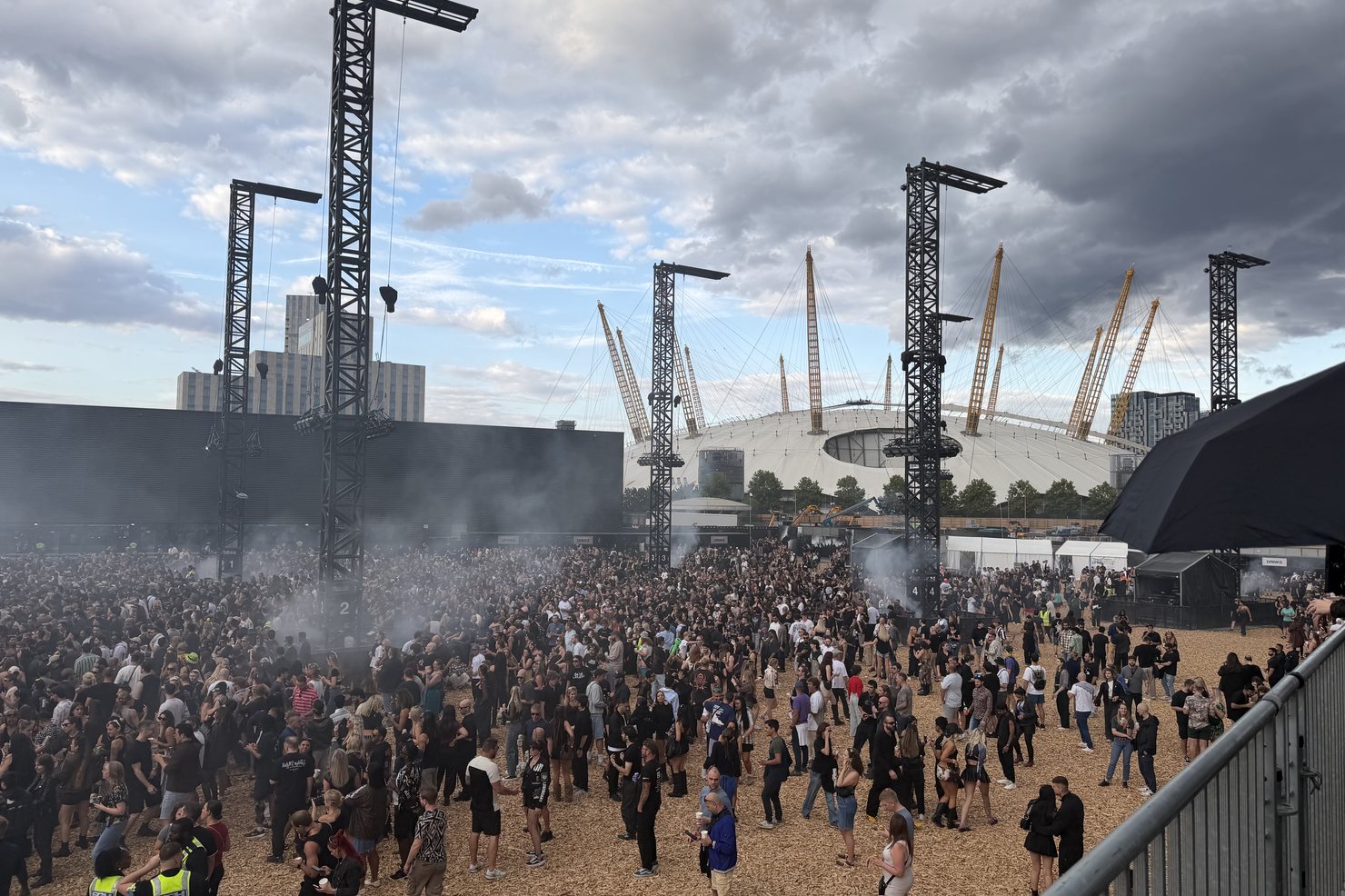
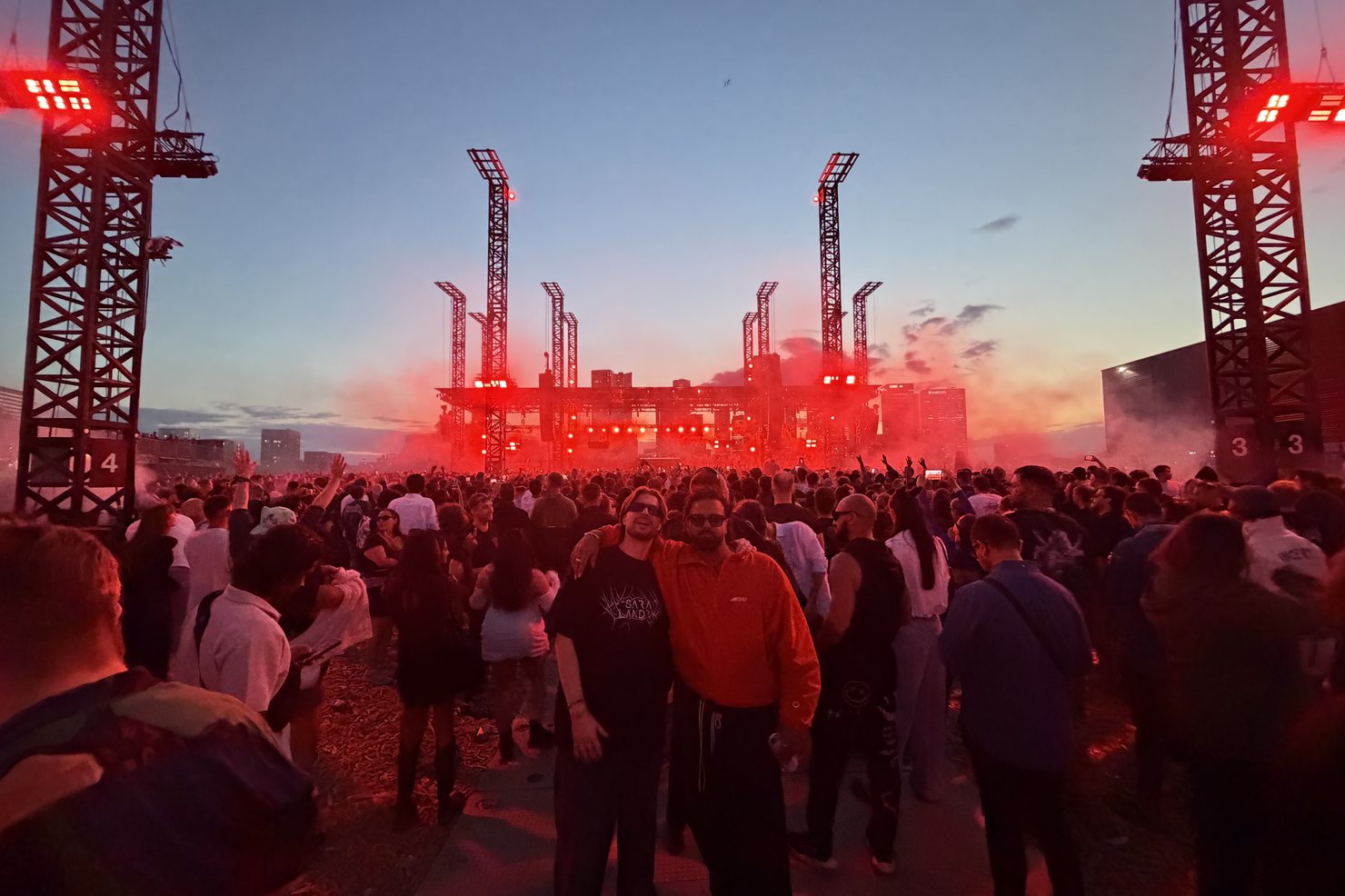
The honest read: it is a big, functional, beautifully lit field, and in its first season that is exactly what it should be. The light show was genuinely excellent, some of the best lantern-and-rig work we have seen at a London day event this year. The skyline does half the production's job for free. What the site has not yet had time to grow is an identity of its own, the way the best London rooms carry one. Right now it is a vast, well-run canvas that each show fills with its own character. First seasons are for exactly that, and the raw material here is better than most venues ever get.
One main stage carried everything, and there is a real opportunity hiding in that. Whole stretches of the site sat far enough from the system that the music softened to a murmur, which plenty of people used as a natural decompression zone, a place to actually talk. If a future season ever drops a small, intimate second stage back there, a one-stage field becomes an event you can move through. The ground for it is already waiting.
The floor is a note for next season rather than a complaint. Most of the ground was covered in wood chip (loose and uneven, fine for standing, harder to really dance on) while a proper platform ran through the central zone, which is naturally where the dancers concentrated, ours included. Extending that decking outward would let the whole field dance the way the centre already does.
And one discovery in the site's favour: the viewpoint. It looked, from below, like a VIP enclosure; it turned out to be open to absolutely everyone. Up there the night ran at a different temperature: quieter, more intimate, the skyline doing its work. It became the best-kept non-secret on site.
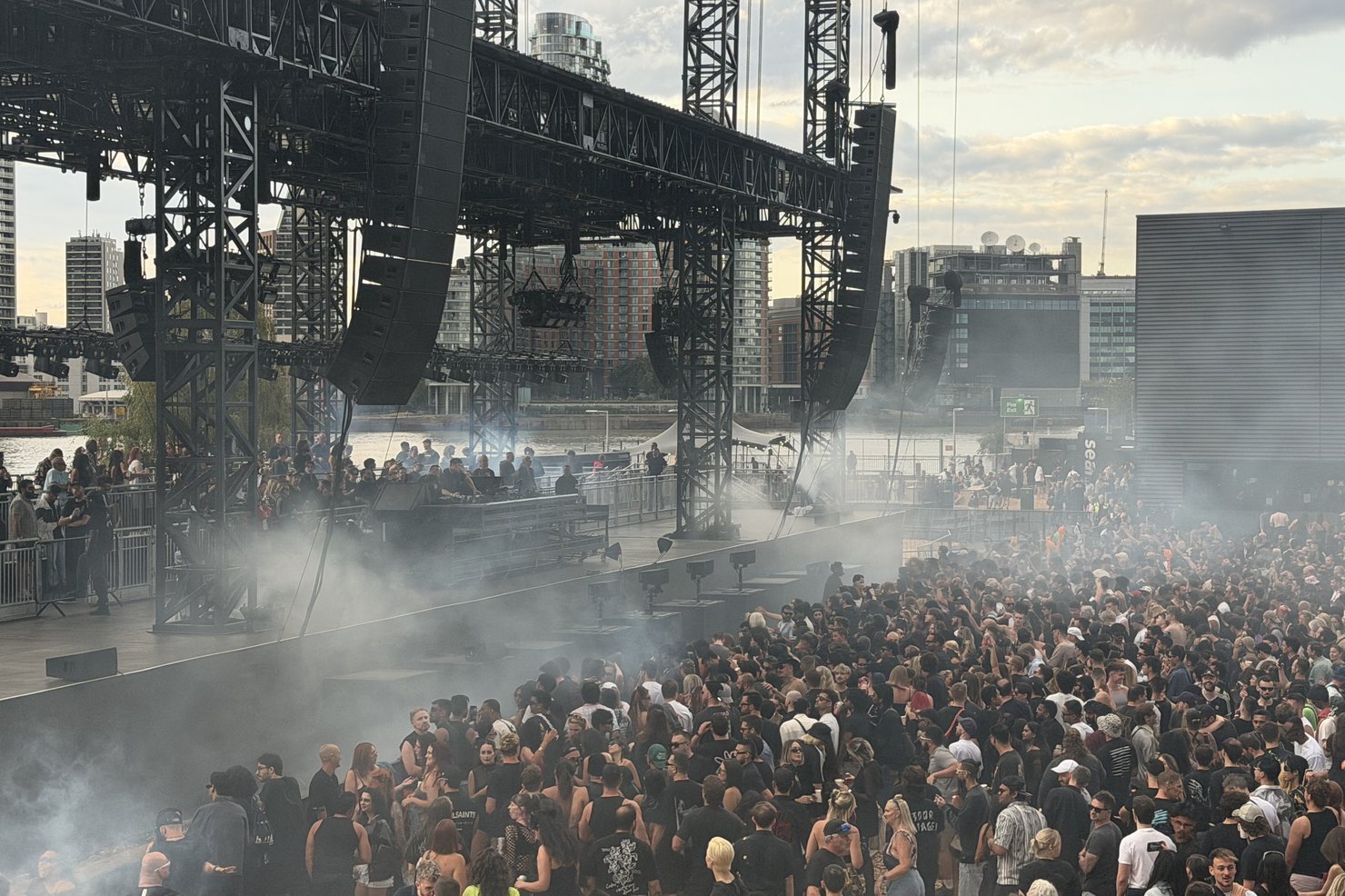
The crowd that made it
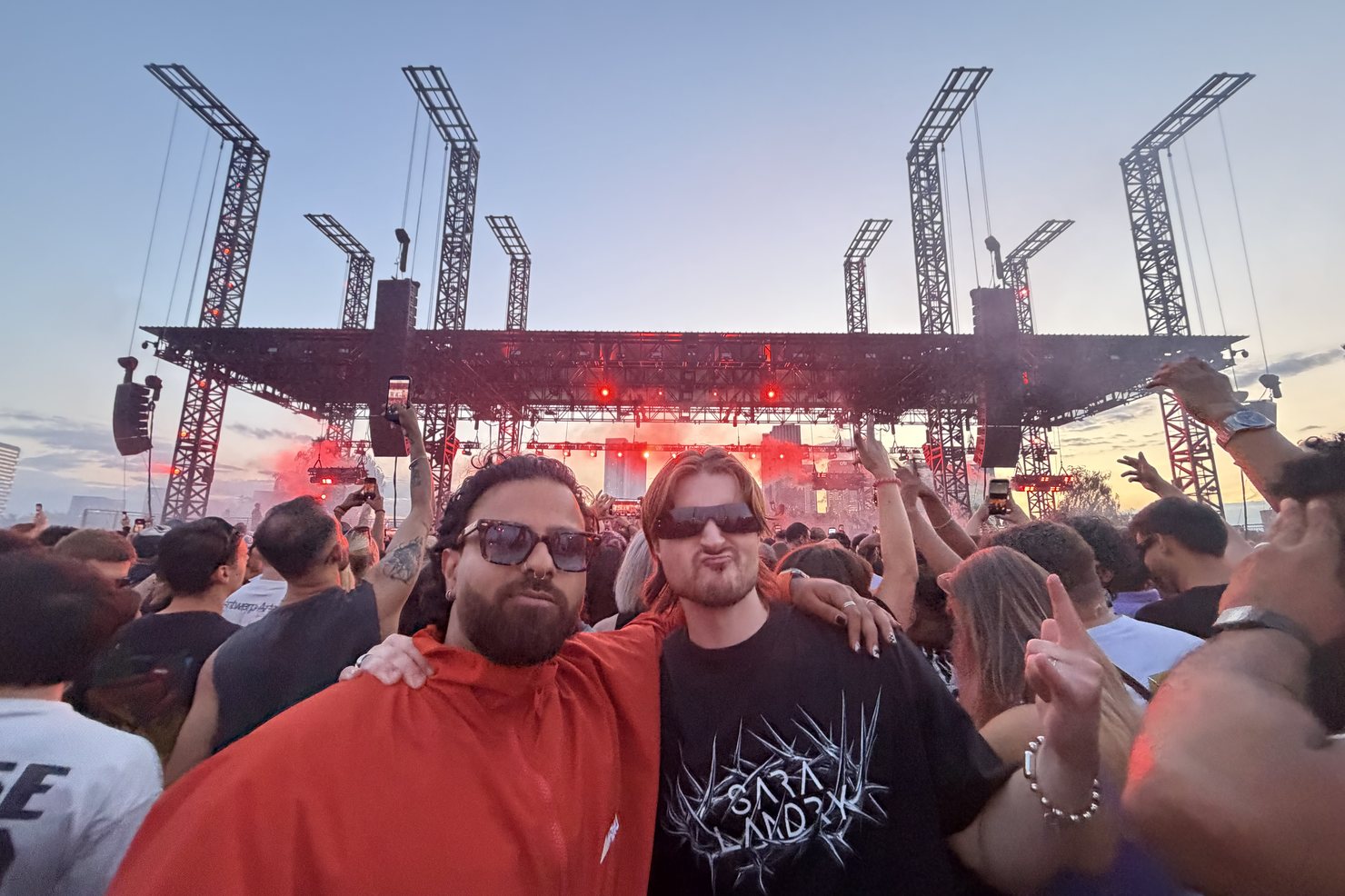
The crowd was the healthiest thing about the night: genuinely mixed, with every generation represented: young hard techno kids next to people who clearly did their raving in warehouses two decades ago. Our estimate put the field at around five thousand at peak, roomy inside the site that Broadwick and production partner Engine No.4 built out.
It filled in the strangest way. TicketSwap was flooded with resales before the event, and when we walked in, the site was so empty we assumed the sell-through had collapsed. Then we went to the bar. By the time we came back, five minutes and no more, the field had jumped from what felt like a third full to full. An entire crowd arrived, seemingly all at once, and the empty field became a proper rave in the time it takes to order two drinks.
The Neon Black delegation
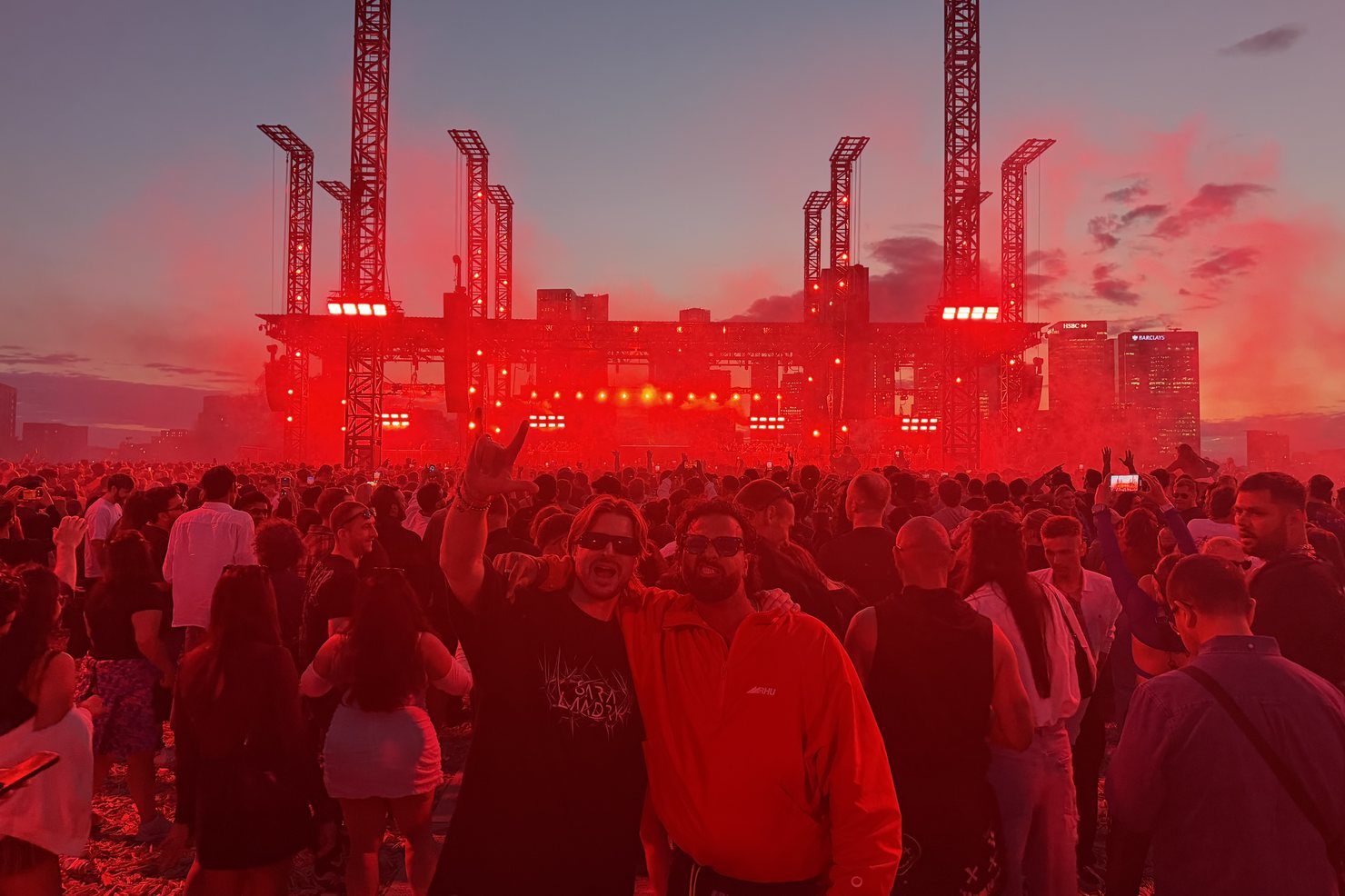
CABBA LAGA did not go alone. Beside him all night, in the red jacket in FIG. 06, was Ravi Sharma, the founder of Neon Black, the Embassy Gardens creative space built around grooming, design, fragrance and culture that GQ has covered, and House of MNEEMO's partner on two summer takeovers now: the formula there is simple: House of MNEEMO brings the sound, Neon Black brings the setting, the aesthetic and the identity.
That partnership is exactly why this pair watches a show differently from the rest of the field. Sharma's whole thesis (he has said Neon Black "was never conceived as a barbershop" but as "a creative environment that happened to offer grooming", and that the goal is "building a world, not just a business") is the same test we applied to the site above: does a space carry its own identity, or is it a canvas waiting for one? Between them, a DJ who opens House of MNEEMO's nights and a founder who designs environments for a living spent the evening reading the field the way promoters read a room: where the second stage could go, where the decking should run, what the light rig was doing right. Most of the notes in this report were argued out between the two of them somewhere between the viewpoint and the platform.
The small stuff that matters
The operational notes are small and easily fixed. It was a cold night for August, and the merch stand carried T-shirts only. A hoodie on those rails would have sold itself, and we would have bought two on the spot. Consider that a free tip for the next date.
The other note is capacity planning around the toilets: roughly two blocks served the whole site, and by mid-evening the queues had grown long: easier for men, thanks to the urinals, and noticeably tougher for women. Add the low fountain-style sinks and missing sanitiser, and it is the one part of the night where the infrastructure had not yet caught up with the production, which sets a very high bar everywhere else. More blocks next season and the problem disappears.
Verdict
Magazine Open-Air's hard techno night delivered where it counts: a sound system that (one hiccup aside) let you stand front-of-house without earplugs, a light show worth the trip on its own, and a booking London will not see repeated soon. In a city that has spent years counting the clubs it has lost, a new riverside site run by people who know how to build these things is unambiguously good news, and the notes above are first-season notes (wood chip, a second stage, more toilet blocks), all trivially within reach for an operation of this calibre. The crowd, meanwhile, needs no fixing at all. On the night the equipment blinked, five thousand people held the room for a quarter of an hour, soundchecked it by committee, and handed it back to Sara Landry louder than they received it. Whatever this series becomes, that part is already world class.
FAQ
What happened during Sara Landry's set at Magazine Open-Air?
Shortly after Sara Landry came on, the sound system developed loud interference from one side of the rig (crackle and distortion consistent with a connection fault) and the set was paused for roughly ten to fifteen minutes while engineers worked. She returned to a huge crowd reaction, and the system ran cleaner and slightly quieter for the rest of the night.
What is Magazine Open-Air?
Magazine Open-Air is a series of open-air shows launched by Broadwick Live, the group behind Printworks and Drumsheds, which ran across six dates in August 2026 (14 to 16 and 21 to 23 August) on a previously unused riverside site next to Magazine London, 11 Ordnance Crescent, on the Greenwich Peninsula.
Who played Magazine Open-Air on Friday 21 August 2026?
The bill was headlined by Amelie Lens b2b Sara Landry, billed as their first-ever London b2b and a UK exclusive, supported by SPFDJ, Dax J, Grace Dahl and DJ Hyperdrive, running from 16:00 until 22:00, with last entry at 20:00.
Is Magazine Open-Air connected to Drumsheds?
Yes: both are operated by Broadwick Live. On site the connection is hard to miss: the branding, screens and upcoming-show announcements follow the same playbook as the Tottenham venue.
What else is in the Magazine Open-Air 2026 series?
The first season ran across six dates on two August weekends: Meduza with James Hype (14 August), Josh Baker b2b Max Dean (15 August), the Soulection 15-years show (16 August), the Amelie Lens b2b Sara Landry night reviewed here (21 August), a Purple Disco Machine takeover with Flight Facilities and Jayda G (22 August), and an R&B and slow jams day closing the season on 23 August.
Who covered Magazine Open-Air for House of MNEEMO?
CABBA LAGA, the DJ who opens House of MNEEMO's London nights, reported and shot the event from the floor, attending with Ravi Sharma, the founder of Neon Black, the Embassy Gardens creative space that partners with House of MNEEMO on its summer takeovers.
Why is the venue called Magazine London?
It is named after the government gunpowder magazine that stood on the Greenwich Peninsula from the 1690s, once the state's main store for newly milled powder. The magazine was relocated to Purfleet in the 1760s, but the area kept the name: the venue's address is still Ordnance Crescent.