Wireless Festival 2026 Cancelled: What Happened & Why
- MNEEMO

- Apr 14
- 7 min read
Updated: 6 days ago
The cancellation of Wireless Festival 2026 was not a freak event. It was the predictable result of a structural model that the UK festival industry has been quietly running on for years.
The short answer
Wireless Festival 2026 was cancelled on 7 April 2026 after the UK Home Office withdrew Ye's Electronic Travel Authorisation, blocking him from entering the country to perform. Because Ye had been booked as the sole headliner for all three nights at Finsbury Park (10-12 July) and no other acts had been announced, Festival Republic had no festival left to run. Within eight days of the headliner announcement on 30 March, four major sponsors had withdrawn, the UK government had publicly condemned the booking, and the festival was over. The deeper story is what the cancellation reveals about how UK festivals are now built, and why that structure was already failing before Wireless 2026 happened.
Key facts
Cancelled: 7 April 2026, after Home Office withdrew Ye's ETA on grounds his presence was "not conducive to the public good"
Dates that didn't happen: 10-12 July 2026, Finsbury Park, London
Headliner: Ye, booked for all three nights, no other artists announced
Sponsors withdrawn: Pepsi (5 April), Diageo (5 April), Rockstar Energy (6 April), PayPal (6 April)
Time from announcement to cancellation: 8 days
First-choice headliner: Jay-Z, before negotiations failed
Operator: Festival Republic, division of Live Nation Entertainment
UK festival market context: 78 UK festivals fell in 2024, 39 by mid-2025, 34% decline since 2019 (AIF data)
The Wireless Festival 2026 Cancelled Timeline
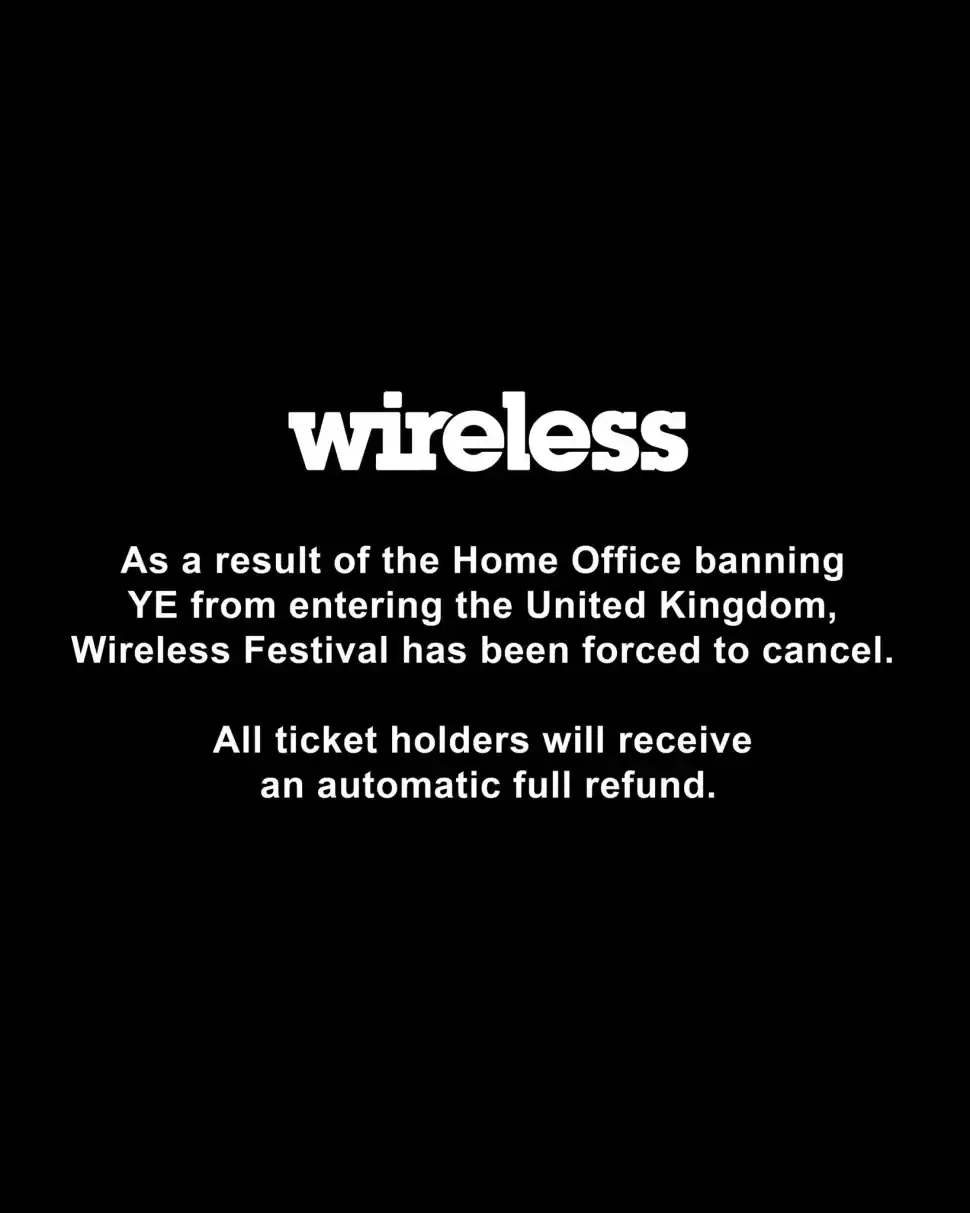
The collapse moved with unusual speed. 30 March, Festival Republic announced Ye as sole headliner for all three nights of Wireless 2026 at Finsbury Park, his first UK performance in 11 years since headlining Glastonbury in 2015. 5 April, Pepsi withdrew sponsorship after a decade-plus title relationship that had branded the festival "Pepsi MAX presents Wireless" since 2015. Diageo, owner of Johnnie Walker and Captain Morgan, followed the same day. 6 April, Rockstar Energy (a PepsiCo brand) and PayPal both pulled back. 7 April, the Home Office withdrew Ye's Electronic Travel Authorisation, and Festival Republic announced full cancellation with automatic refunds to all ticket holders.

Total elapsed time from announcement to dissolution: eight days.
The speed itself is the data point. Festivals do not normally collapse this fast. They negotiate, they restructure, they replace headliners, they survive sponsor exits. Wireless Festival 2026 cancelled because of how the festival had been architected, not because of any single shock.
The Single Point of Failure
Here is the most important fact about why Wireless Festival 2026 was cancelled, and it is the one most coverage has buried: no other artists had been announced. Not a single supporting act. The entire festival, three nights, 50,000 daily capacity, was built around one performer.
Jason Euler, a partnerships executive who works on more than 450 live events per year, named this exactly when speaking to Skift Meetings: "This is a textbook example of a single point of failure. When that artist couldn't enter the country, the entire event structure unraveled."
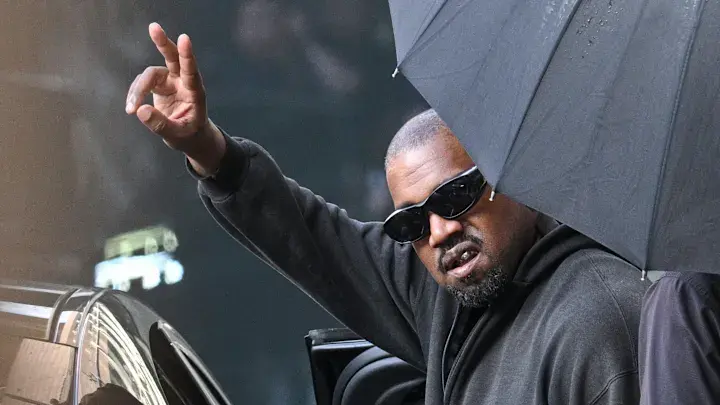
Festival Republic was attempting to repeat the 2025 Wireless model, where Drake had headlined all three nights with three different setlists. That residency was the first of its kind in the festival's 20-year history and sold out in record time. The Drake template became the operating logic for 2026: book one cultural mega-act, build the entire weekend around them, eliminate the cost and complexity of programming three different headlining bills.
The model worked once. Drake's brand was stable. The 2026 attempt to repeat it with a different artist exposed exactly how much hidden risk the model carried. According to IBTimes UK, Jay-Z was the original first choice for Wireless 2026 before negotiations failed, after which organisers turned to Ye. The pivot from one residency act to another was treated as interchangeable. It was not.
Pepsi Signed Off, Then Pepsi Bailed
The most operationally damaging fact about the cancellation came from Festival Republic Managing Director Melvin Benn himself, in an interview with BBC Radio 4's Today Show shortly before the cancellation, reported by NME. Pepsi originally approved and signed off on the Ye booking before withdrawing publicly when backlash hit.

That admission breaks something fundamental about how festival sponsorship is supposed to work. The premise of having a long-term title sponsor is that the brand has institutional alignment with the event, that decisions are vetted before public exposure, that the partnership functions as risk management. What the Wireless 2026 cancellation showed is that brand partnerships now operate as one-way exit options. Sponsors will sign off privately, then bail publicly the moment social pressure mounts, leaving the promoter holding the operational and financial bag.
Festival Republic's official cancellation statement attempted to address this directly: "Multiple stakeholders were consulted in advance of booking Ye and no concerns were highlighted at the time." The Campaign Against Antisemitism's response, reported by Complete Music Update, was sharper: "Who were they consulting? A wall?"
The lesson for any UK festival operator watching this happen is that sponsor sign-off in 2026 is not contractual cover. It is provisional approval that evaporates under pressure. That changes how every future major UK festival has to think about programming risk.
The Bully Album Context
Festival Republic did not book Ye for Wireless 2026 in a vacuum. The booking sat inside a broader commercial calculation tied to Ye's twelfth studio album Bully, released through YZY and Gamma on 28 March 2026, two days before the Wireless announcement.
By measurable commercial standards, Bully worked. It debuted at number 2 on the Billboard 200 with 152,000 album-equivalent units, blocked from number one by BTS's Arirang (Variety, 11 April). Critically, the reception was harsh: Pitchfork rated it 3.4 out of 10 and Rolling Stone gave it 2.5 out of 5. For Festival Republic, the streaming numbers explained the booking logic. What the booking calculation missed is that streaming popularity and physical festival demand are no longer the same metric. The audience that streams a polarising artist out of curiosity is not the same audience willing to attend a three-night live event under that artist's name when sponsors and government are publicly distancing themselves in real time.
A UK Festival Sector Already in Crisis
The Wireless 2026 cancellation did not happen in a healthy market. It happened inside a UK festival sector that the Association of Independent Festivals (AIF) has been describing as in active crisis for two years.
The numbers from AIF research are stark. 78 UK festivals fell in 2024 (cancelled, postponed, or closed permanently), more than double the previous year. By June 2025, 39 festivals had already fallen in the first half of the year alone. The total number of UK festivals has dropped from around 900 in 2019 to 592 in 2025, a 34% decline in six years. AIF CEO John Rostron has publicly stated: "There will be more festivals out there who are close to making this call."
Of the 592 UK festivals still operating in 2025, only 250-300 exceed 10,000 capacity. Live Nation alone controls roughly 24% of total UK festival ticketed capacity, around 880,000 across its portfolio, prompting AIF to formally request that the Competition and Markets Authority investigate Live Nation for anti-competitive behaviour.
In other words, before Wireless 2026 was even announced, the UK festival circuit was already losing one in three of its events, dominated by a single corporate operator, and structurally vulnerable to exactly the kind of sponsor and regulatory shock that took down Wireless. The cancellation did not break a healthy system. It broke one that was already breaking.
Why London's Small Rooms Are Winning
The argument that follows from this data, from inside the London scene where MNEEMO has been building HOUSE OF MNEEMO nights across the city all year, is structural. The centre of gravity in UK live music is moving from large outdoor festivals to focused, well-programmed smaller venues.
Small rooms reward risk and intimacy. Festivals punish both. The rooms across London where HOUSE OF MNEEMO nights have been built this year are part of a circuit that is structurally less exposed to the failure modes that took down Wireless. None of these venues depends on a single artist for three nights. None has a multi-million sponsor concentration risk. None is one Home Office decision away from total dissolution.
The XOYO reopening, documented earlier this year in interview with Kirk Allen, reinforces the same trend. London's club infrastructure is being rebuilt around long-term venue thinking, residencies, and programming continuity. That is the opposite of the single-headliner residency model that Wireless 2026 attempted. The current MNEEMO catalogue on Radar Records is being built for exactly this kind of room, not for stadium fields.
What the Cancellation Means Going Forward
Three things the UK festival industry now knows that it did not formally know before 7 April 2026.
First, single-headliner residencies are not a programming innovation. They are a concentrated risk position. The Drake 2025 success made the model look repeatable. The Ye 2026 collapse shows what happens when the model meets a different kind of artist. Future bookings will have to price this risk accurately or stop booking the format entirely.
Second, sponsor sign-off is not contractual cover. Brand partners will withdraw under social pressure regardless of what was approved internally. Promoters who plan around long-term sponsor stability are planning against current reality. The Pepsi case made this explicit on the record.
Third, the UK Home Office has demonstrated willingness to intervene in cultural bookings through the ETA mechanism. That power existed before April 2026. It is now operationally visible. Every future booking of a high-profile international artist with a controversial public record now has to factor in the possibility of last-minute regulatory cancellation.
For artists, promoters, labels, and venues operating in UK music in 2026, the lesson is structural. Build for resilience, not for single-night maximum exposure. Diversify sponsorship dependence. Programme rooms where the audience comes for the venue and the curation, not just for one name on the poster. That is the lane that survived the week Wireless Festival 2026 did not.
Published 14 April 2026. This editorial is part of House of MNEEMO's ongoing coverage of the electronic and club music scene, written by London-based DJ and producer MNEEMO — millions of streams to his name and a party series running through some of London's best clubs. Listen to MNEEMO: Spotify · Instagram · YouTube